2.10.2010
Super special report
10.01.2009
The Odyssey of a Simple Task

I received a call in March of this last spring from a man who lived in
I took a long, deep breath. Just completing a project of trying to procure dogs for single scent detection work through a myriad of breed rescues unwilling to indenture their dogs to a life of servitude; shelters unwilling to place potential candidates in homes that did not support their version of ideal; and breeders wanting exorbitant dollars for candidates yet unproven, I, like a fool, said OK.
The logistics of creating a Service/Assistance dog are incredible. First one has to find one. Most of the larger organizations breed their own, but the success rate is mitigated by health, trainability and temperament issues that change the dynamic throughout the development of any working dog. The actual training is a long and arduous process that can take many months and then finally, hopefully, successful placement of the trained dog with the right person.
Her first birthday was
The Hierarchy of Need

For me, right NOW; it’s internet access. My business runs on it, I depend on it to stay in contact with friends, relatives and clients and I write. Not for a living, but let’s just say that the internet is at the apex of my personal needs at this very moment.
9.28.2009
Adventures behind the dashboard of a Ford Expedition

More Chikin Tales


8.16.2009
Alas, alas. My kingdom for an egg.
We had our false starts. A week ago we came upon an empty shell and began combing the grounds for eggs ever since.
So here it is, our little pearl; found nestled atop the straw bales behind the pen.
Sent from my Verizon Wireless BlackBerry
7.13.2009
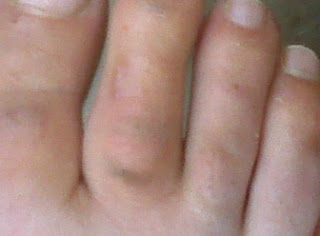
Foist by my own Petard or, does this look broken to you?
For decades I extol the virtues of wearing the proper clothing for dog training, comfortable, weather appropriate clothing, closed shoes...
Yeah, about the closed shoes.
Well there really IS a reason, of which I in my arrogance clearly needed a reminder of.
Working a young, relatively weighty dog on a drag line, I was casting him to a training table and in his effort to avoid the request I smartly stood on the line with my left foot and scooped the slack with my right to urge him with a bit of leash pressure to go to the table from a distance of about 8 feet.
Super-cool maneuver as the purpose of the task was to remind the dog that my hands were free but correction can come from any source.
Having done this thousands of times before ( in appropriate shoes, of course) I was wholly unprepared for any problems for my sandaled feet.
Lo and behold, the line runs across my right toe, down below the second toe and along the tops of the remaining toes and as I pop the line to the left to take out the slack and redirect the dog; I feel a sickening snap as my toe is bent awkwardly into a position I am sure that toes are neither accustomed to, nor designed for.
Ouch. Is about all I can say.
That, and please wear appropriate shoes.
Sent from my Verizon Wireless BlackBerry
6.01.2009
Dear Blog, Please forgive my absence...
I do not believe I have ever been that sick in the entirety of my life.
I also hope that I am never that sick again. Now I am left with the remnants of a sinus infection and the copious nose blowing that accompanies this time of year for me.
My chickens have grown up without me, the coop is still not built but they have grazing opportunities during the day where I can keep a watchful eye on the nest of red tails just adjacent to the property.
My girls are not dull birds, they see the shadows overhead and squawk in alarm as they run frantically to the cover of the big Alder behind the house.
The dogs are starting to settle in to the presence of the noisy, fragrant intruders with only the mildest of curiosity; my eldest, Cotton, was accosted by my largest hen when he became to curious for her liking.
He apologized humbly and distanced himself from her chicken rage.
My pup, not so much.
She thinks the birds are of the most entertaining of sorts, passing up the opportunity for a run in the long, overgrown pasture and the stream for a deliberate study of the funny looking not-ducks and how to access them.
No pictures this day, but I am sure more opportunities will avail themselves in the future.
4.20.2009
Don't Feel Much Like Dancin'

FWIW, the weather sucks here today, even after the glorious weekend and the MAJOR accomplishment of finally getting the main garden bed tilled and in the final stages of Ready. As in, for planting.
Not like it mattered much though in the long run, I'm on my fourth day of flu, my first day upright and mobile and clean past the essentials soldiers learn about in field hygiene.
But it is raining like crazy here. My freshly tilled garden looks more and more like a mud wrestling pit and my back is achin' just looking at all the goodly sized rocks that will need to be husked out of that mess before any real planting can occur.
I thank Larry for the use of his tractor and tiller. I know what's first on my Christmas list this year.
That and all the time in the world to play on it.
But I digress.
Before my fatal collapse into physical turpitude on Thursday night, I had the pleasure of working with a young lab student and was able to introduce her to her first bird work.
She really didn't want to put that in her mouth. Cute-n-fuzzy or not...
The pup's a good egg though. Clearly the hatchling is too.
4.14.2009
Chicken Adventures

Well, I finally did it. I am now the proud owner of 15 baby peeps. Five Black Australorp and ten Buff Orpington pullets.
My son likes them, my dogs wonder if they would be better served on toast or with au jus. My husband is just rolling his eyes at my most recent hair brained scheme...
The dogs slather over the stock tank with the funny noises coming out of it, my Pointer is correct in his assumption that there are birds in there, but doesn't seem to understand that I do not need them pointed out to me.
The Pug has taken a deep interest in them, not so much as a potential snack as a genuine affinity for their cuteness.
The Lab thought the stock tank was for swimming in, not raising day-old peeps. She is decidedly unimpressed. Although she thinks they look like they could be much fun.
My son has already started naming them. Omelet is the name of the biggest Buff, and Gloria is the name of the smallest Australorp. She is easily identifiable by the quantity of white on her little flight feathers and around her eyes.
The Buffs are gregarious birds, the Australorps are rather shy and reserved, although they are warming up to the physical handling they recieve daily.
For such little things, they sure do eat a lot. And poop a lot. Fellow blogger Heather Houlihan alerted me to the consequences of paste and how to remedy it's appearance, so I was cleaning peep poos instead of supervising dog poo for their first few days here.
All are well now, eating, drinking and pooping merrily.
They will be living in their new digs as soon as construction is complete. More pictures to follow.
Eventually, they will be joined by about 25 Cornish rocks for the freezer.
4.08.2009
More Poo Chronicles... or "Don't You Die on MY WATCH!"
I have become a wizard of the poop scoop 'flick' that can get even the most difficult or sticky poo off the ground and into the scoop shovel. Long grass and putty poo? No problem. Syrupy straining from stressed pups? Gotcha. I wholeheartedly prefer the easy, firm little turds of healthy, happy dogs, but occasionally, well... I don't get my way.
More disgusting yet; I scrutinize poop. I look at it closely. It is a harbinger of physical condition for it's donor and a quick screening can determine a lot about it's donor's health.
Although poop is good, no poop can also be a sign of trouble too. Especially if your poopee is a 'regular'.
In a previous blog I had written about the 'stuff' that dogs eat and the anguish that accompanies the 'passage' of said stuff.
I had 4 Residency Training dogs here at one time for being consummate consumers of stuff. For days, I leash walked these critters many times a day, each and every outing so I could do two things:
A) Be assured that they didn't eat more stuff
B) Be assured that what remaining stuff they had consumed prior to their residency was passed successfully.
I am not surprised at neither the quality or quantity of stuff I retrieve with my sooper pooper scooper the first few days of a dog's residency.
Most recent in the news is a dog who consumed about $400.00 and successfully passed it, much to his owners dubious delight.
I was not willing to determine the denomination of the pale green bills that were excreted by one of my recent guests. I guess I would have if I saw a few zeroes on what remained of the corners.
It may have been worth my while. But, then again....
One of my charges, the second half of a team of Labradors (like no-one saw THAT coming) came for his residency once he was released from the vet after his obstruction surgery over 3 weeks ago.
His owner was concerned that four days after his surgery, he was allowed to access a squeaky toy and yup, you guessed it; was able to eviscerate the toy and ingest the plastic bladder that makes the noise.
The owner was away at the time of the incident and the pet-sitter who was in charge of the dog dutifully took him to his surgeon over the weekend to x-ray the abdomen and see if they could find it.
They saw a staple from his most recent surgery but it looked like the plastic squeaky bladder was at the mouth of the small intestine and it was anticipated that the plastic bladder would 'pass' without assistance.
The sitter took that as a good-enough-for-her answer and returned the dog to his home.
The owner relayed this story to me when she dropped him off for his training with assurances (to the best of her knowledge) that the dog had in fact, passed the plastic bladder. She could not be positive however, as she was not there the weekend of the incident.
Goat Belly II (GBII) came in on the day his house mate, Goat Belly I, left. That will be 14 days ago tomorrow.
GBII settled in nicely, ate well, relieved himself with great regularity with nice healthy little ploops that you could have used as golf balls; grass free, debris free, money free, tylenol bottle bits free. Honest-to-goodness nice poop.
He settled into the training well, learned to "leave it!" and "out!" as well as the requisite obedience training that occurs here. His bowels remained tight and regular.
That is until Sunday night.
My husband took him out for his last ex of the evening and commented frustratedly on his spirited attempts at eating large clumps of the new grass that dot our landscape. "Leave it", "Out" and "DAMN YOU, STOP IT"!! were unsuccessful. He ended up hauling the dog back to the house, all the while trying to control his sudden voracious appetite for our grass.
I offered him water, put him in his crate and within minutes, he proceeded to demonstrate exactly how far an adult male Lab can spew his dinner across my dining room floor. He was fine otherwise. I cleaned him up, mopped my floor and kept a close eye, but his posture was normal, he was comfortably curled up in his crate, alert and fine. He has passed a normal stool earlier which I made my husband point out for me to scrutinize.
I was concerned, but not alarmed.
Monday morning, our routine remained much the same. I took out the small dogs, fed the breakfast eaters and watered them as they all returned from their morning constitutionals.
GBII had a nonproductive outing (odd, I thought. He always goes in the AM) refused his breakfast (Labs on their death beds still eat) and with only a tiny bit of water made available to him, proceeded to repeat the events of the night before. Resplendent plumes of gritty bile across my hardwood floors, only about 6 feet this time as opposed to the entirety of it's 15 foot length.
I called the owner, I called the vet, we were on our way within 30 minutes.
An exray revealed a vaguely familiar shape in the colon, well on it's way to the rectum.
Finally.
After 18 days, Goat Belly II finally passed his last artifact.
4.07.2009
Of Interest to Anyone who Eats Food
I am in direct opposition to H$U$ and think they are the Devil's Spawn but at the same time, I have some pressing concerns about the Nation's food supply.
Other blogs have addressed this better, addressing the discussion to pet food products with a caveat that the food supply in this country feeds us all. Human and animal alike. A Google search for pet food recall or contaminated food conjures up list after list, page after page, of food products that are additives or whole source foods for humans too.
Agri-business has much to atone for with the recent outbreaks of salmonella in the human food supply, from greens to nuts, including my absolute fave, pistachios.
Aw, nuts!
Who can forget the huge expose' on the pet food industry only a few years ago? Some news services considered the public outcry an "overreaction". You know, like, it's just pets and all... So a few people died. Who cares!!
My concern is that it is beginning to appear with a sinister regularity in our headlines. What people are simply failing to understand is that the affected foodstuff is impacting the consumer supply for every domestic animal and human in the nation.
So where does this alarming and remarkable article from VIN fit?
Lifted directly from the article:
"Veterinarians spend their lives promoting the well-being of animals. Yet at the same time, activists appear to be guiding America’s attitudes on animal welfare, experts say, working to erode veterinary medicine’s authority on the topic and divide the profession."
With a correction to it's authors; H$U$ and PeTA have no interest in 'animal welfare'. It is all about animal rights.
An example of this from the article:
"While the American Veterinary Medical Association (AVMA) carefully weighs scientific evidence to establish opinions on what’s in the best interest of animals, HSUS and its cohorts are preening their message, using emotion to drown out the more moderate voice of organized veterinary medicine."
There is not a lot of consensus over this or any topic that has more than one set of "experts". Large animal vets are accused of being deep in the pockets of agri-business while small animal vets endorse more humane practices for animals raised as food.
I am on two sides of this argument:
I could give a rat's arse about agri-business; they have done more to destroy the fabric of the family owned and operated farms and homesteads (of which I am a product) in favor of mass producing a food supply whose very existence endorses dubious practices in husbandry and safety for the consumers of their products.
So. Does the H$U$ have a point? Sure it does. But should they be the ones dictating the practices of agri-farms and food producers?
H$U$ suggests that animals raised for food should be kept in a more 'natural state', enabling them to pasture in open areas, be able to move about freely without restraint. Opposition contends that "...such mandates merely trade one set of welfare concerns for another. Animals housed in open systems are more vulnerable to disease, parasite infestation and injury due to aggressive pen-mates. The system also makes it more difficult track an animal’s medical health and care, AVMA officials contend."
So, who's right?
The real fear is the ultimate agenda: "... those who liken HSUS to “PETA-light extremism” fear the organization’s fingerprints on agriculture housing bans are a precursor to the group’s ultimate agenda — to end animal ownership and remove meat from the diets of Americans."
Jack Advent, OVMA executive director stated, “What we do know is that if there is no dialogue, HSUS has stated that they will simply collect the signatures they need to go to the ballot where the electorate will decide on the issues. We don’t want to close the door to something like legislation, which could be far more palatable than what might be on a ballot initiative.”
H$U$'s strategy has clearly demonstrated superiority in the devious department. They have successfully created strategies by targeting communities with a small agricultural footprint where opposition would not be significant, coupled with their appeals directly to the public instead of through introducing legislation which would have likely been opposed by lawmakers and/or lobbyists.
The article states "In 2002, voters in Florida — one of 24 states that allow for citizen referendum — became the nation’s first to enact a ban on swine gestation stalls after HSUS waged a two-year publicity campaign and gathered more than 600,000 signatures to get the issue on the ballot. Five years later, Arizona voters outlawed gestation stalls by 2012. It reportedly cost Arizona's agriculture groups roughly $1.6 million in a failed bid to combat the HSUS message. Both states have very little in terms of swine operations."
Wow, huh?
California's Prop 2 passed in November with over 63% of the vote, which analysts say will devastate "... the future of the state’s egg industry, and many hope that a bill currently playing out in the state Legislature will level the playing field for California’s producers by imposing free-range requirements on eggs imported from other states."
Peter Weber, executive director of the Illinois State Veterinary Medical Association is relieved that similar legislation proposed in Illinois failed in February, stating that "It was abundantly clear that this bill plays to people’s emotions. There just isn’t the science to back the need for it.”
The veterinary community's decidedly neutral stance is pretty ominous. Their inability to come up with a plan of their own allows for H$U$ to intervene where they truly have no business. That the system needs to be changed is not really the issue. It has been clear for years that it does.
The USDA's inability to adequately police agri-business lends itself to reform. A more proactive role in the safety of our food supply is necessary to assure it "fit for consumption".
Food is big business, for ourselves and our animals. The two are related. There is not a lot of oversight in the pet food market and precious little effective oversight in the human consumer markets.
Legislation is becoming increasingly restrictive in the production of low-cost food for consumers allowing the slow food and locavore movements to gain momentum. By providing attractive alternatives to agri-business and the food/animal controversy, a locally produced food source encourages consumers to take a more proactive role in policing their own food supply.
It has a far healthier impact on local economies as well and promotes a broader concern for the welfare and safety of our consumer goods.
Sometimes the old ways are best. Supporting the production of locally raised food products has been a cultural icon of the United States since the beginning of our country's history. Only since the return of the soldiers from WWII has agri-business forced small family owned farms to surrender to a greater demand for goods and monopolized the production of food for the nation.
The government subsidizing of growing 'more, faster' has had a profound impact on our safety, our health and the sustainability of our food supply. With the depletion of the aquifers in the Midwest, we face a far greater danger as the agri-businesses loose their ability to maintain high volume production for a teeming nation of fast food consumers.
It is within our ability to make a statement about our concern for the food we feed not only our animals, but ourselves and our children. At the same time, the dictatorial practices of H$U$ is clearly not the way. In order to preserve our rights as consumers and suppliers we must take a more active role in the production of our food supply.
There has got to be a better way.
3.19.2009
Trolling for Puppies: The TRUTH??? To be filed under Gimme a $%^& Break
In their sincerest belief that they are providing assistance to "puppy mill dogs" and shelters purportedly overrun with unwanted pets, they are offering purebred puppies for sale, er 'adoption' through a sanctioned pet store.
A Puppy-Store-Free LA's tag-line "...is to end the sale of puppies at pet stores in L.A."
But it's OK if they do it, right?
___________________________________________________________________
Excerpts from the article follow, anything within the parentheses are mine.
"Eight months ago, Best Friends LA launched A-Puppy-Store-Free LA to stop pet stores from selling puppies because, sadly, that doggie in the window comes from a puppy mill. Not only is this a heartbreaking situation for the dogs being forced to breed in deplorable conditions, but for the new pet parents, as well."
(Sadly, there is still a doggie in the window, but this one is BETTER because you are SAVING it from the horrors of being sold in a pet store. Do you honestly think that the source is any different or any better for these pups? What is THEIR source for dogs? Have they started their own captive breeding program???)
"A puppy purchased from a pet store can cost up to $1,500. More often than not, these sweet new additions have congenital disorders and may die with in the first two years of life due to inbreeding and unhealthy living situations. Few families can afford the thousands of dollars on unexpected vet bills and many puppies are surrendered to shelters, where they are euthanized or wait in vain for a new home. Most never get that second chance."
(But a puppy purchased, er 'adopted' through us is an endorsement of our belief that all breeders are bad and that our pet shop is different and somehow better than other pet shops. Cuz we sell designer pet clothes and green products, and and and, puppies!!! Yeah. Ok. Uh Huh? But few families can afford the undisclosed vet costs for unforseen events from your puppies either, can they? Or have you specifically selected for genetic defects in your shelter dogs and screen for congenital defects in your neonates and follow the most astringent health conscious protocols available? I want to see a guarantee that the buyers, uh, 'adopters' of your pound pups are contractually bound to return the dog to YOU if something goes wrong. What't that? As an agent of the shelter who provides your product, you can't make such a guarantee? Indeed. And you are better than the Hunte Corp and PetLand how?)
"Best Friends has been hard at work to find an alternative, and collaborated with Woof Worx (formerly Pets of Bel Air) on the idea to sell wonderful, healthy, purebred puppies that come from local shelters. For a mere fraction of what it would cost at a traditional pet store, people can adopt one (or more) of these dogs, support a business that’s doing the right thing, and save a life."
(An ALTERNATIVE? Are you nutz? Wonderful, healthy purebred puppies from WHERE? Where are the local 'shelters' getting them from? Oh, oh Sorry I forgot! From the confiscation of animals by the new ordinances being passed like wildfire in your state and others thanks to our pals at H$US. For a 'mere fraction' of the cost at a traditional pet store! YOU ARE A TRADITIONAL PET STORE!!! Adopt my ass. Buy. Face it. You offer a commodity and people are paying you MONEY for that commodity. But of course, under the protection of the law that should come as caveats for anyone falling for this bunk. What is your guarantee that these pups will not fall victim to congenital defect, hereditary defect, communicable disease or die by the age of two? Are you going to take them back? Are you going to pay for their vet care when it is discovered that your product is as defective as PetLand's? What is the recourse for the consumer, er, 'pet parent'? Adopt one or more? What happens if one gets returned at say, 4 or 5 months old because it is a behavior issue or the owners are 'moving' or whatever the lamest excuses that shelters usually get. What then? Where do the puppies go? Hold on a minute there Nelly, in a community that is endorsing the limitation of pets owned by it's citizens, are you actually telling me that your employees are going to do 'home visits' and all that? Riiiiiiiiight..... And the save-a-life thingy. Sounds like a marketing ploy to me.....)
"Jamie Katz, owner of Woof Worx, proudly opened the doors last weekend to over 150 supporters of this new concept. Veggie hors d’oeuvres and wine were served at the beautiful, high-end pet store in the heart of Bel Air."
(I bet she was proud. Came up with a really good way to make money, uh, stay in business, er help the plight of puppy mills being sold in pet stores and make it look like she was doing something good for the community. To 150 supporters no less. At the beautiful, high end PET STORE in the heart of Bel Air!!! Who is buying this crap? Are the people of this Nation so indoctrinated that they can no longer see the forest for the trees?)
"Available dogs were there to celebrate their new lives, as well. This is not a typical store where puppies are kept in cramped confinement on newspaper or plastic flooring. Think of it as an indoor dog park. The puppies had toys, individual soft beds, even an indoor pet potty. A comfy couch is in the puppy room for anyone who wants to get acquainted with their potential new family member or just be covered with puppy kisses."
(Available dogs are everywhere, like at traditional shelters who could really benefit from this kind of BS PR. This is not a typical store. OK, then mandate that all pet stores, just like your pet store, are as wonderfully equipped. Tell me. After operating hours, where are all the dogs housed and how are they cared for? Is there someone there to clean up after the potential family members overnight and on days where the shelter, uh, non puppymill supplied pet store is closed? Lemme guess, they are 'free range' in the indoor dog park.)
“We are so thrilled to be partnering with Jamie Katz, the owner of this beautiful store, and to support her in her efforts,” says Elizabeth Oreck, BFLA manager. “We truly believe that traditional pet stores that sell dogs from puppy mills will soon be a thing of the past, and that a store like Woof Worx will become a national model for cities all across the country."
(Oh I bet! Especially that part about traditional pet stores being a thing of the past, since yours will represent a new age income stream because instead of your product coming from puppy mills or from unscrupulous dealers who will find a way to continue to supply the new niche you have just created, it will be stocked with purebred puppies born...where? Are shelters going to start their own breeding program for purebred dogs? Gonna have to if HSUS has it's way and effectively shuts down hobby breeders who actually care about the quality, health and longevity of the animals they create.)
“This is not only a great way to showcase rescued animals who need homes, and to help lower the number of dogs and cats in our drastically overcrowded shelters, but an opportunity to educate the public about animal welfare issues. And we are so grateful to Jamie for taking that leap and being willing to show the rest of the country that a successful pet store can be modeled on compassion rather than cruelty.”
(A better way would be to stop offering purebred puppies and bring adult shelter dogs of ANY breed or mix of breeds and sell, uh, adopt them instead!! Drastically overcrowded shelters? C'monnnnn! Stop importing dogs from the islands, overseas and focus on the ones in your own back yard!!! And besides we all know that shelter population numbers are an amalgam of both cat and dog numbers when in fact the cat populations outstrip dog populations in shelters 3 to 1.*
Thanks for making a cunning business decision and finding a way to keep the doors open and showing the rest of the country how to game the system and still make a profit!! Sure the store is nice, with all of the high-end Californication trappings of wealth and do-goodery, but thanks for admitting that it's still a pet store.)
Katz was an employee of Pets of Bel Air when BFLA began its peaceful protests.
“I always knew in my heart that selling puppies this way was wrong,” she says. “I’m a huge animal lover and advocate of animal welfare.”
(And probably had really good grades at business school)
Katz acquired the store when the original owner of Pets of Bel Air lost his lease, due in part to Best Friends’ protests.
(Whalp, waddya know? And this was on her own capital or through funding of BFLA?)
"Jennifer Krause, puppy mill campaign coordinator, thanked all the volunteers, supporters and Jamie. “This is a huge victory, and we couldn’t have done without them. Jamie just gets it.”"
(Why Shore it is, for all of the MBA's in business, let this be your model.)
____________________________________________________________________
Here's the thing. I hate pet stores that sell pets, and I hate the suppliers who provide them with product at such considerable cost and sacrifice to living, breathing animals.
I also hate duplicity and being wanked by the absolute bullshit that surrounds a campaign by those who allegedly (new favorite word) are in it for the animals.
I hate that the gubmint is trying to dictate to me the number of animals I am allowed to own, that they have bits and pieces that are their birthright and that this movement is being endorsed by people who claim to have the best interests of animals at heart.
Many questions emerge:
1) Who is supplying this new demand for purebred dogs if all of the breeders are put out of business and shelters are advocating spay and neuter for every animal that crosses their doorsteps?
2) Dogs are going to be the new crack cocaine if this comes to pass. How can this organization reconcile the belief in an overpopulation problem and turn around and endorse the continued sale of purebred dogs in pet stores? I would LOOOOOOOOOVE to have seen THIS business model!!!
3) Why can't they make this believable, even palpable, by just creating a storefront in affluent areas to elevate the consciousness of the wealthy elite to the plight of dogs of every stripe, not just purebreds, not just puppies?
4) What do you think is going to emerge from this new business model?
*Statistically, this figure bears out across the nation. Stray cats comprise the largest single number in shelter populations for both animals housed and animals euthanized. But we are dealing with California here, so I am using a California statistic. More info can be had here.
The question arises about the actual accuracy of supplied numbers from a variety of recognized sources. Usually the number of animals in a shelter is defined as dogs AND cats as opposed to dogs, then cats. Statistics can be parsed to say anything and should be viewed with concern for their accuracy in accounting for the segregation of the total numbers.
Defining Dogs
There is a Great Divide in dogs today. The interpretations below are based on the context of their use through the ages, dating back many decades wherever dogs and humans found themselves together.
In his book 'Fetch and Carry; A Treatise on Retrieving' by Bernard Waters (circa 1894) the argument was much the same. I can remember these discussions way back in the late '60's and 70's when I acquired my very first dog; an Irish Setter from a renowned breeder in my area. My brother and I hunted over this dog and his successors for years, something that would not be thought of today, with all that hair, with none of those brains...
Working Dog: a dog that has a job, like hunting, retrieving, scent detection, protection, stock work (more commonly called herding), Service and Assistance dogs, Search and Rescue, even diagnosing human ailments. Working dogs are traditionally bred to a purpose-specific task; their parents were Working dogs as were 90% or more of the animals represented in their pedigree.
They are genetically endowed with qualities that make it easier to teach them their life tasks since they have a genetic predisposition to do so. Working dogs can be but may not be purebred. They are often recognized by performance registries where the emphasis is not on racial purity, but in the ability to perform a specific task well.
Show Dog: a dog that may or may not originally have been bred for a task-specific purpose, is the product of breeding practices that are more focused on looks than performance to a specific task, may be attractive in the way Paris Hilton is attractive (pleasant to look at but vacuous and not a serious contributor to anything of real value), but are considered useless by Working Dog standards.
An occasional Show Dog may in fact be a Working Dog, but it does not occur with the regularity that it had in previous, even recent, generations. Some Show Dog breeders think that their Show Dogs are as competitive in working dog venues as intentionally bred Working Dogs, but they are truly not. Show Dog breeders adhere to a principal of function following form where Working Dog breeders adhere to the principal of function above all.
Show Dog people thing Working Dogs are ugly. Working Dog people thing Show Dogs are genetic cesspools and stupid. Show Dogs are always purebred, are recognized by purebred dog registries, are judged on the merit of their looks as conforming to a written standard overseen by parent breed clubs and giant registries like the American Kennel Club.
Pet Dog: can be a Working Dog, can also be a Show Dog, but is often heard as a term of derision from Show Dog communities who consider a 'pet dog' to be of little value and of less genetic quality. The Pet Dog is often a dog acquired for the purpose of 'being a pet' or companion to humans in a human environment, like a home.
Pet dogs can serve many purposes, are often recognized for incredible acts of heroism and bravery and there are approximately 70 million of them throughout the United States. (based on a census where the collected statistics were generated through the tracking of license purchases and subsequent registrations of individual ownership from reporting communities across the nation. It is not an accurate number of owned dogs, it is simply a numeric sampling of licensed dogs). Pet dogs outnumber Working or Show dogs, since most people just want A Dog, not a specialty dog.
Purebred pet dogs are the byproduct of what Author Donald McCaig calls "Victorian Excess".
Either way, there has grown a colossal market for the production of purebred dogs for a consumer market and most recently for 'designer breeds' of dogs who have been successfully marketed as somehow superior to purebreds.
Pet Dogs can come from many sources; Show Dog breeders really don't breed as many litters as some people would have you believe, but they supply more pets to the Pet Dog buying market than they do Show Dogs to the show dog buying market. Since it is not that easy to breed a Champion Show Dog, many breeders breed for years in pursuit of anatomical perfection with limited success.
Historically, there are very few multi-Champion litters of any breed, so the numbers of pet dogs produced from Show Dog litters is proportionately higher than pet dogs from Working Dog litters, which are known to produce proportionately higher numbers of Working Dog prospects than Show Dog litters are for producing Champion Show Dog prospects.
Got that?
A pet pup from a Show Dog litter is no guarantee of soundness, smarts or working ability, and the only thing you can be assured of is that they look like the breed they are supposed to represent. That is not to say that there are not good, versatile Show Dog breeders; there are. I have had several successful working dogs from Show Dog breeders who were judicious in their selection process of sires and dams, genetically screened all of their breeding stock and had a variety of genetic wells from which to dip from, either domestically or from overseas; preventing the genetic bottleneck that occurs with a lot of dog breeds that are over-bred (through popularity, which is the death knell for all breeds) and heavily used individuals (Popular Sire syndrome). There is a number of Sporting dogs who can still successfully fulfill the task of their original conception and purpose over other traditional working breeds, but these numbers are dwindling rapidly.
Although a pup acquired from Working Dog blood is no guarantee that he has what it takes to fulfill his original intent, Working Dogs produce working pups with high energy levels and a keen desire to work. Not all working bred pups will end up as working adults, but the percentages of carefully planned Working Dog litters yield more working capable dogs than the most carefully bred Show Dog litter yields Show Dog Champions.
A pup from a Working Dog litter is a better guarantee of soundness, smarts and working ability, and the one thing you can be assured of is that they perform like the breed they are supposed to represent. There is a disproportionate number of 'Working' and 'Herding' breeds of Show Dogs who are incapable of fulfilling the task of their original conception and purpose over individuals bred exclusively to purpose, and these numbers are growing rapidly.
True Working Dog breeders produce the lowest average numbers of puppies overall, breeding only to incorporate new blood into already successful breeding programs and to replace their aged working dog with a new pup. They are careful how they breed and how they place their puppies.
So where does one get a 'pet'?
There are a variety of places to get a dog, but first one must define what (s)he wants in a dog.
If you absolutely must get a 'Designer Dog', please be careful that you are selecting a pup from a breeder who has seen past the dollar and is selecting sires and dams that are genetically clean of the diseases that are inherent for their respective breed(s). Junk bred to junk will produce more junk, no less so than in purebred dog populations. Just because it has a hefty price tag, it is no guarantee of quality or soundness.
If you must have a purebred dog, the same rules apply. Research the breed and look for breeders who certify their breeding stock against the diseases that each and every breed is predisposed to. It is not so much that there are Champions in the pedigree, it is more important that the breeder is conscientious enough to carefully select good breeding partners who are genetically 'clean'. Expect to pay more. Careful breeders are more concerned with where their pups end up and maintain a responsibility for the pups long after they leave the whelping box.
If you have decided to graze a couple hundred head of sheep, are a policeman looking for your next K-9 partner or an avid hunter looking for the premier hunting companion to take afield, look to breeders who's breeding programs reflect excellence in performance in those events. Purposefully bred working dogs are not easy to breed, nor are they easy to come by. Increase your success rate of getting the dog you want by looking in the right place to begin with.
Thoughtful breeding always produces good dogs, whether they are Show Dogs, Working Dogs or just pets.
You increase your likelihood of finding a good dog if you research before you buy. Talk to professionals, like Groomers, Pro Trainers, kennel boarding facilities for input on what the 'easy keeper' breeds are.
Stay away from breeders who sell on the internet. Although an internet presence is often a means to view many of the dogs a breeder has produced, good sites don't offer dogs for sale through the site and will require you to contact them directly before any purchase is possible. Visit a couple of breeders in your area. Although many breeders do have stud dogs, most conscientious breeders will more often opt to breed their bitches to dogs from other breeding programs to enhance bloodlines they already have.
You should ALWAYS be able to see the dam of the litter and although she may be protective of her brood, look to see that she is well cared for and in good weight. If the sire is from another area, ask to see pictures, look online for awards he may have received or if possible, view video clips of him at work or in the ring. Through the popularity of the internet, much can be learned from databases created by many breed or performance dog clubs and as a result, massive online resources are available.
There are always shelters and breed rescues local to you as well. If you are looking for a pet, but are not interested in the commitment a puppy requires, there are always local alternatives for older dogs and even purebred dogs through these sources. Every dog is entitled to a good home and if you are willing to acquire a pet through a shelter or breed rescue, you would be amazed at the variety of animals available through these alternatives.
Extreme Sheep Herding
This is a laugh riot!
3.18.2009
Superfluous Act of Reconciliation

I played a little, teeny tiny role in the success of National Geographic Channel's Dog Whisperer show.
It's time I atone.
Although many, in fact whole organizations, may lay claim to first allegiance, it was in fact I and a little correspondance I intercepted that started a whole chain of events that led to the eventual airing of the show, and it's continued success on the air.
Some people will hate me for this.
Some people will thank me for this.
Most people will go on blissfully unaware or unwilling, to acknowledge my role in the success of the Dog Whisperer show.
But it's all there. Any current member of the International Association of Canine Professionals on or about August 2004 should remember or anyone with access to their Yahoo Groups archives can look up a post by me directed to the SafeHands list on the 26th of August under my ALCOEUR email address. (message 19801)
I'm not a gold digger, nor do I care that the success of the show has marched largely on without me; I was a successful, full time Professional Dog Trainer prior to my involvement with either the IACP or the subsequent association of Cesar Millan and the IACP, and will continue to be so long after my association with either party is at an end. One hopes anyway.
But in the interest of the genesis (my new favorite word besides 'ostensibly') of this post and the last five years of angst over the Dog Whisperer show and Cesar Millan specifically, here is the post I sent to National Geographic's website after intercepting a rather threatening consortium who had tasked themselves with the mission of not having the show air at all.
(My outrage was not from their allegiance to any one method or dog training philosophy, but their unadulterated willingness to eviscerate our constitutional right to free speech and the freedom of expression.)
Here it goes, before it is lost forever:
"I applaud your efforts to provide a demonstration of dog training on the National Geographic channel. I am sure that by the time you read this post, you have already been inundated with posts from around the globe from a faction of people alleging that what you will be televising is 'old fashioned', 'unscientific', 'cruel' and possibly even potentially dangerous to both dogs and
humans. Although I myself have neither seen the teasers for this show nor excerpts, I assure you that after almost 30 years of working with dogs, including dangerous ones, and using a variety of methods, I doubt that you would display something over the airwaves that poses a threat to canines or humans.
In an oversimplified view of their world, where most of their practical dog training experience comes from working with perhaps their own pet dog and a lot of books, they have limited scope on the reality of dog training, and what it may take to achieve success with a non compliant, difficult dog. 'They' being the collective 'Positive only' dog training camp who utilize only two of the four learning quadrants all animals employ. Although science is a convenient way to attach nomenclature to an activity or behavior, what it fails to do successfully is to take out of the laboratory or the book and successfully apply that nomenclature to a practical, real life experience.
Positive dog training should mean successful dog training, but the very term has acquired a life of it's own, demeaning the application of methods that are both ageless and timely. Ageless, since no living thing can survive successfully without consequence, as your specials on animals living both domestically and in the wild have shown us, and timely because by the time a professional
trainer gets a call for someone's wayward pet, that dog has achieved inappropriate levels of disobedience that the owner wants resolutions to immediately.
For the numbers of pet dogs in the world today, there are infinite ways to train them, all depending on the nature of the dog, the behavior one is trying to extinguish, age of onset, and a whole host of other variables that need be taken into consideration.
Traditional training methods are traditional because they work. The methodology invoked requires skill and are often misaligned by the Positive only camp as cruel because they have never seen them demonstrated correctly, if at all. To intimate that they are potentially harmful is an excuse for this inappropriate use or demonstration. Take for example the words "choke collar". It's proper use is slip or training collar. It has one application, is worn by the dog in one specific fashion, and is the most maligned article of equipment in the dog training trade today. How it acquired it's malicious use as a 'choke collar' is simple. When applied incorrectly, it does not release automatically, nor would it if it is fitted incorrectly.
By virtue of it's simplicity, it can only be used one way successfully. So, instead of the trainer invoking it's usage incorrectly being the target for education, all training collars are 'bad' and should never be used.
A 'correction' is another term that is not only misunderstood, but horribly misapplied in the context of the new vernacular. To 'correct' a dog physically is harmful, causing stress and emotional trauma. In nature, consequences drive survival. if a wild animal cannot learn from it's failures, it is doomed.
Take for example some of the wild canidae.
As a collective unit, known as a pack; they seek, drive and bring down large game.
The social hierarchy determines who eats first, who mates first, who sleeps where. If a wolf is driven from the pack, as is often the case of adolescent males, they must learn to survive without benefit of the assistance of the pack. Their own unsuccessful attempts either make them better hunters, or drive them to starvation. Discomfort is a part of natural life, for humans and animals.
What better correction to a toddler who accidentally touches something very hot. The parent may have reprimanded the toddler verbally to stay away from a hot surface or item, but curiosity is often the best teacher as the toddler equates the words "don't touch, it's HOT!" to the burning sensation on his fingertips as he reached for the iron or stove top.
Much is the same with dogs. A correction can be as simple as a verbal reminder, "NO!", or a snap on a correctly applied training collar. It is an attention getting aide to assist in communication between two species. Teaching "human" to a dog is far more time consuming than teaching "dog" to a human.
With the advent of electronic training devices, this communication occurs even more readily between the two, and has even wider applications for the training of dogs previously determined to be "beyond training".
I am sure there are dozens of "trainers" who have no skill in the correct application of either traditional training equipment or methods who have done more harm than good. They have besmirched an honorable profession that is still in it's infancy. There are precious few of us who support ourselves exclusively as "Dog Trainers".
We could only do that continuously if we provided a product (training) that was both successful and satisfactory to both dog and owner. I seriously doubt that if we, the collective Professionals who actually sustain ourselves as trainers to the pet owning public, were to beat, choke, kick or otherwise abuse dogs, would survive successfully as trainers.
In a society where the 'management' of dogs is preferable to the training of dogs is a horrible injustice to both dogs and their owners. What a person wants in a pet is the nostalgia of a 'boy and his dog" from years gone by. The comfort of a family pet, protector and friend who is a pleasure and a joy to live with. It is a blatant disservice to so noble a relationship as the one we
share with our first friend, the dog.
National Geographic enjoys a storied history of worthy publications, information and photographs that have enlightened generations of people from around the world. Although as I watch this program, I may not agree with everything applied by Mr. Milan, I am certain you will reach millions of people who would otherwise not seek professional help when they witness what training their pet can accomplish.
Thank you, and many more successful years of education and entertainment to you.
_________________
What really surprised me whas when I got a response from one of their Executives, Michael Beller later that afternoon:
Dear Linda,
Thank you for taking the time to share your thoughts about this series. We appreciate your support. You will be hearing more from us soon, but in the meantime I wanted to ask how you heard about the series and the controversy. Are there websites where this is being discussed? For a program that has not even aired yet, it certainly is generating some heated debate. We hope you'll watch and continue to support the series.
Please do not share my e-mail address with anyone, I would prefer all comments to continue come in through the comment site. But I wanted to give you my address if you would be so kind as to respond to my questions about the source of the debate Thank you.
Regards,
Michael Beller
_____________________
So I responded.
The original email is lost, however I distinctly recall activities on one of those inane listservs that populate the internet on pets and behavior. I was also party to some indiscreet conversation amongst some 'trainers' regarding the series, the star and the messages it may convey to an unsuspecting public.
My email was then forwarded by Mr Beller to a gentleman named Russell Howard who contacted me via phone later that same afternoon.
__________________________
Here is my report to the IACP SafeHands list:
"Mr. Beller forwarded my email to Russell Howard, Executive VP of
Communications in Washington, DC.
He called me yesterday evening and we spoke at length about the training industry and the complicated issues surrounding the "positive only" factions and those of us who consider themselves "balanced trainers".
I had provided both Mr Beller and Mr Howard for the websites of IACP and NADOI so they could read the Position Statements of both organizations. I also provided a bit of background information on the formation of IACP and APDT, and where a lot of the difficulty between the two lie. I also provided the web address for the APDT, in all fairness.
It IS an issue of censorship, amongst other things, but the primary hope of the National Geographic executives, in defense of their program choice and subject matter follows in Mr. Howard's email to me as follow up of our conversation."
_______________________
And here THAT is:
"Hello Linda,
It was good talking with you earlier.
We very much appreciate your support for our upcoming series "The Dog Whisperer" and your insight on the balanced vs "positive-only" dog training debate.
I wanted to let you know that we have forwarded your contact info to Randy Rylander, one of our senior researchers, who has been working with us on this series.
Randy will follow up with you on some of the questions that you and I discussed. Specifically, we were hoping you might be able to help direct us to individuals you feel would be receptive to reviewing this show without a prejudiced point-of-view against all dog training techniques other than a "positive-only" method. We also would like to identify someone in a senior role from NADOI and/or IACP who would be willing to speak with press on the topic.
Thank you again.
Best,
Russell
RUSSELL A. HOWARD
VP COMMUNICATIONS
And the rest, as they say, is history.
_____________________________
I contacted stewards to both the IACP and NADOI for input and comments and sought the pillars of the dog training community to assist with the review that the executives of the show had requested.
Cap Haggerty was one, Margot Woods was another. Tony Ancheta, Heather Houlihan and myself were the first possibly ever, to see the show before it even aired.
I still have the first four or five episodes from that very first season on tape and unedited.
_________________
Why now, after all this time you may be asking, do I really think anyone actually gives a rats patootie?
I don't really, exceptin' about every 5 months or so, the topic raises it's insidious head like the Spectre of Death and the townsfolk shake their pitchforks and melt their silver to make shivs and bullets.
Because even all these years later, Millan and his show are still a hot topic. Bloggers, pseudo science, and average Joes are all still talking about him; Professional dog trainers are either maligning him or capitalizing on their vague association with him.
And besides, I just wanna stir the pot.
Do I regret my involvement? Naaaaah. Not at all. I think a little discourse is healthy and competition is always a good thing.
Have I benefited in any way from my association with the IACP and their resultant association with Cesar Millan through my actions? I can honestly say; Nope. What others do is none of my concern. My feeling is that the cream will rise to the top, regardless of who they know or how they know them.
I am secure enough in my ability as a trainer, a Professional Dog Trainer to not be overwhelmed by gimics and fads, nor be intimidated by populist opinion.
I just wanna train dogs.